I am an associate professor at SMU's School of Computing and Information Systems and a member of SMU HCI Research. My research lies at the intersection of Human-Computer Interaction (HCI) and accessibility. I design, develop, and deploy interactive tools powered by cutting-edge technologies to support people with disabilities. Through user-centered approaches, I create solutions that enhance independence, improve quality of life, and promote inclusion across diverse disability contexts.
I was a postdoctoral fellow in the Robotics Institute and Human-Computer Interaction Institute at Carnegie Mellon University from 2016 to 2017, where I worked with Prof. Aaron Steinfeld and Prof. Jeff Bigham. Before that, I was a Ph.D. student at the University of Maryland, College Park, where I was advised by Prof. Jon Froehlich.
If you are a student interested in working with me, please see this page for more information.

SCIS 2 Room 4093
School of Computing and Information Systems
Singapore Management University
90 Stamford Road Singapore 178903
+65 6828 9691
Projects
Accessibility and Assistive Technologies
People with disabilities have long relied on others to help them navigate accessibility barriers. Although the internet, mobile devices, and AI have transformed many aspects of accessibility, their future potential depends on whether people with disabilities can use them effectively. Without thoughtful design, these technologies may create new forms of exclusion rather than inclusion. In our group, we aim to addresses this challenge by designing, developing, and evaluating assistive technologies, while investigating how people use technology to understand and navigate digital information and physical spaces. We harness emerging technologies such as VR/AR, sensors, and braille displays to create and improve tools that support greater independence for people with disabilities.
Related Publications:
- Abe, Y., Lin R. X., Hara, K., Sakamoto, D. (2026) Understanding the Feasibility of Auditory Hand-Steering Guidance for Blind and Low-Vision People, in Proceedings of CHI ‘26
- Abe, Y., Matsushima, K., Hara, K., Sakamoto, D., Ono, T. (2025) “I can run at night!": Using Augmented Reality to Support Nighttime Guided Running for Low-vision Runners, in Proceedings of CHI ‘25
- Jiao, Y., Sun, R., Luo, R., Yao, X., She, X., Hara, K., Zhang, Y., & Fu, X. (2025) Tactile data comics: Combining step-by-step presentation of tactile graphics with verbal narration for the blind and visually impaired, in ASSETS '25.
- Köksal, A., Gu, J., Hara, K., Jiang, J., Lim, J., Xu, Q. (2025) SPASCA: Social Presence and Support with Conversational Agent for Persons Living with Dementia, in Demo Track of AAAI ‘25
- Cai, S., Ram, A., Gou, Z., Shaikh, M. A. W., Chen, Y.-A., Wan, Y., Hara, K., Zhao, S., & Hsu, D. (2024). Navigating real-world challenges: A quadruped robot guiding system for visually impaired people in diverse environments, in Proceedings of CHI ‘24
Enhancing Interactions in Indoor Environments
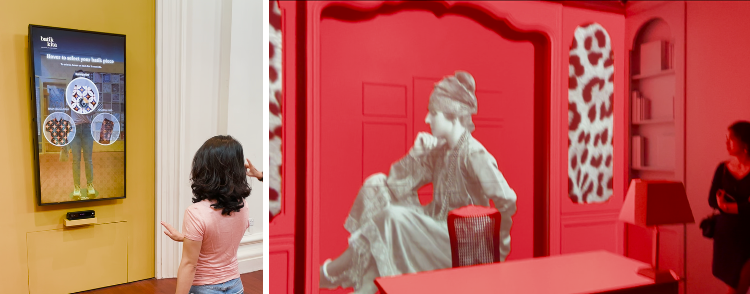
We develop interactive technologies that enhance everyday indoor experiences. We build technical capabilities for mapping, localization, and tracking, then use them to design meaningful interactions. For example, we developed a novel localization technique, which determines users’ indoor positions through natural-language dialogue rather than solely relying on sensing technologies. As users describe their surroundings, a conversational agent extracts and reasons about spatial information in the dialogue, then estimates the user location on existing floor maps. This supports tasks such as navigation without requiring additional infrastructure.
Related Publications:
- Sheshadri, S. and Hara, K. (2025) Enhancing Smartphone-based Inertial Indoor Tracking with Conversational User Input, in Proceedings of ACM IMWUT
- Yonetani, R. and Hara, K. (2025) Map as a By-product: Collective Landmark Mapping from IMU Data and User-provided Texts in Situated Tasks, in Proceedings of ACM IMWUT
- Sheshadri, S. and Hara, K. (2024) Conversational Localization: Indoor Human Localization through Intelligent Conversation, in Proceedings of ACM IMWUT